Contents
- How many days do you actually need?
- When to go — the real seasonal guide
- Getting to Merzouga — routes and road times
- What to expect at desert camp
- What to pack for the Sahara
- Understanding Erg Chebbi
- Beyond the dunes — Rissani, Khamlia, the Tafilalet
- Photography in the desert
- Budget and pricing — what's real
- Common mistakes — and how to avoid them
How many days do you actually need?
This is the question most agencies avoid answering honestly, because the honest answer sometimes means fewer days sold. The short version: three days is possible but rushed. Four days is our recommended minimum. Five days adds the single most valuable day on the entire journey. Six or more days is for travelers who want the south of Morocco to be the centrepiece of their trip.
Here is the longer version.
The 3-day route: possible, not comfortable
The distance from Marrakech to Merzouga is approximately 560km in each direction. On a 3-day route, Day 1 is the drive south (7–9 hours including stops at Ait Ben Haddou and the Atlas pass), Day 2 is one night at camp and the return journey begins, Day 3 is the drive back. The Sahara itself gets one evening — the camel ride, the sunset, the camp dinner, the morning dunes — and then you are heading back. The gorges at Dades and Todra are things you pass through rather than stay in. This route is sold in enormous numbers. It is the most common Sahara itinerary in Morocco. It is also the one most likely to make you feel you needed more time.
The 4-day route: the right minimum
Adding one day breaks the journey in a way that genuinely matters. The extra day is typically spent as an overnight in the Dades or Todra gorge area — which means you arrive there in the afternoon rather than the dark, and you have a morning in the canyon before continuing to Merzouga. Four days gives you approximately 5 hours of driving per day rather than 7–9, which changes the quality of every stop on the route. This is our most recommended starting point for most travelers.
The 5-day route: the best version of this journey
The fifth day is not another driving day — it is a full day at the dunes with nowhere to go. Two nights in the desert means one night to experience the camp and the Sahara, and then one full unstructured day in which you are not a person who has arrived and is about to leave. That is a different experience. People who have done both consistently identify the free desert day as the strongest memory of their Morocco trip. If you are deciding between 4 and 5 days, choose 5 if you can.
6–8 days: for those who want the south properly
Longer trips allow a slower approach, a Fes departure instead of Marrakech, multiple gorge nights, or a loop through the Draa Valley on the return. At 7 or 8 days, the journey becomes genuinely exploratory rather than an itinerary. These trips are built custom — see the Custom Journey page.
Honest decision framework: Ask yourself what you are willing to trade off. Three days in Sahara with less time everywhere. Four days with proper gorge time and one camp night. Five days with a real free day in the desert. If the Sahara is the point of your Morocco trip, not just a box to check, choose five.
When to go — the real seasonal guide
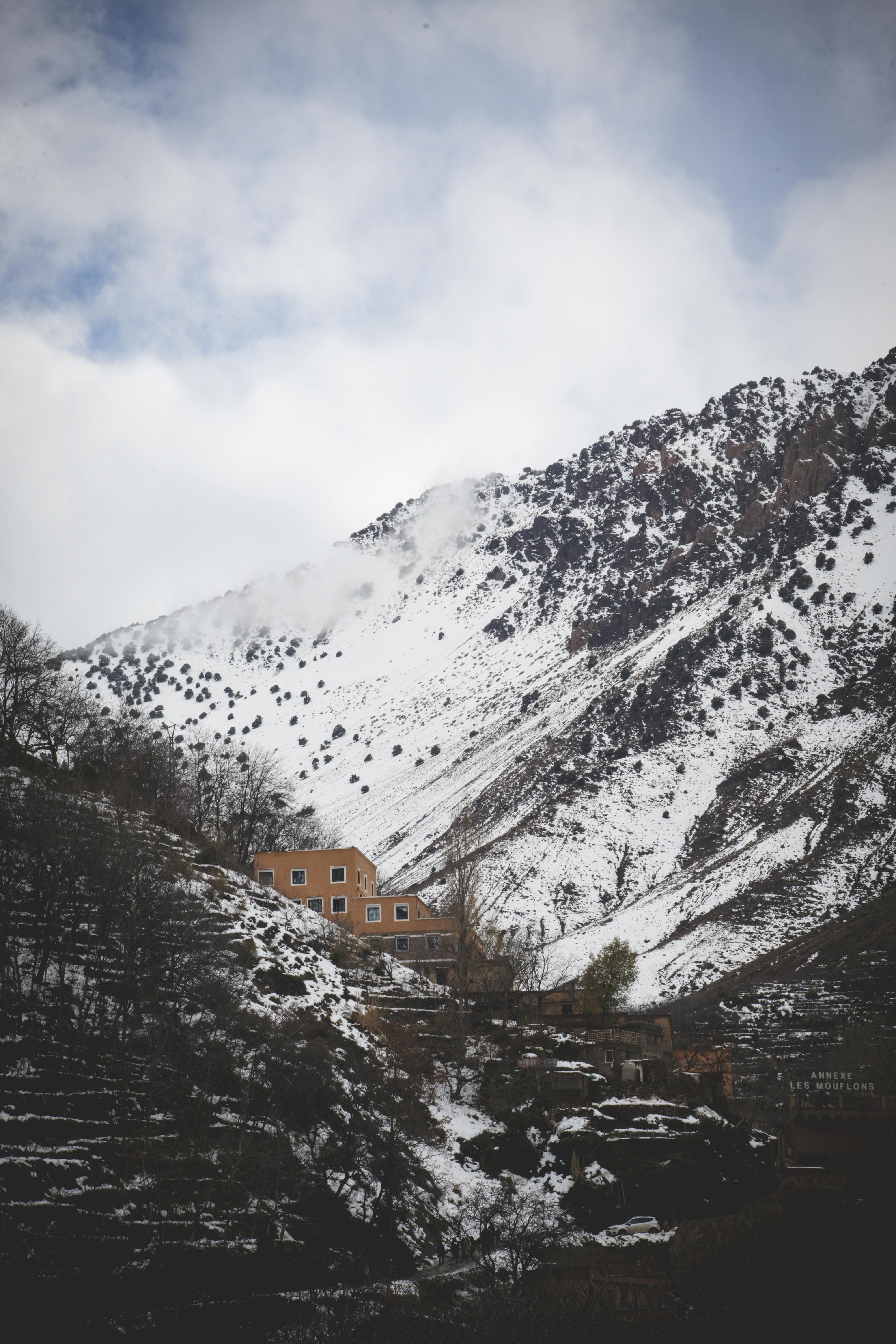
The High Atlas in winter — the Tizi n'Tichka pass can be snowed over in January and February, occasionally closing the road south.
No month is perfect for the Sahara. Every season involves a trade-off. Here is what each period actually involves — not what the promotional calendar says.
Summer in the desert: what it actually means
July and August in Erg Chebbi can reach 46°C in the afternoon. Sand temperature is significantly higher — walking barefoot on the dunes at midday is painful on the feet. This does not mean the Sahara in summer is impossible, but it does mean your outdoor time is compressed to the two hours around sunrise and the two hours around sunset. If you are a photographer or simply someone who wants to walk in the dunes without suffering, summer is the wrong season. That said: camp prices are lower, the Erg is quieter, and the night sky is spectacular regardless of month.
Winter in the desert: what it actually means
January and February nights in the dunes drop to near freezing and sometimes below. Desert tents — even at comfort and premium level — are not insulated to hotel standard. You will need a proper sleeping bag or warm layers on top of whatever the camp provides. The High Atlas pass (Tizi n'Tichka, 2,260m) can be blocked by snow in winter, which occasionally requires a road alternative or a wait. On the other hand: the winter dunes are quiet, the light is extraordinary, and the desert in cold clear air is a completely different experience from the summer version. Many people who visit in winter say it is their preference.
The best months: honest recommendation
October and November in the north, March and April in the spring. These four months give you comfortable daytime temperatures (18–28°C), cool but manageable nights, good dune light, and reasonable crowd levels. If you are flexible, these are the windows to aim for.
Getting to Merzouga — routes and road times
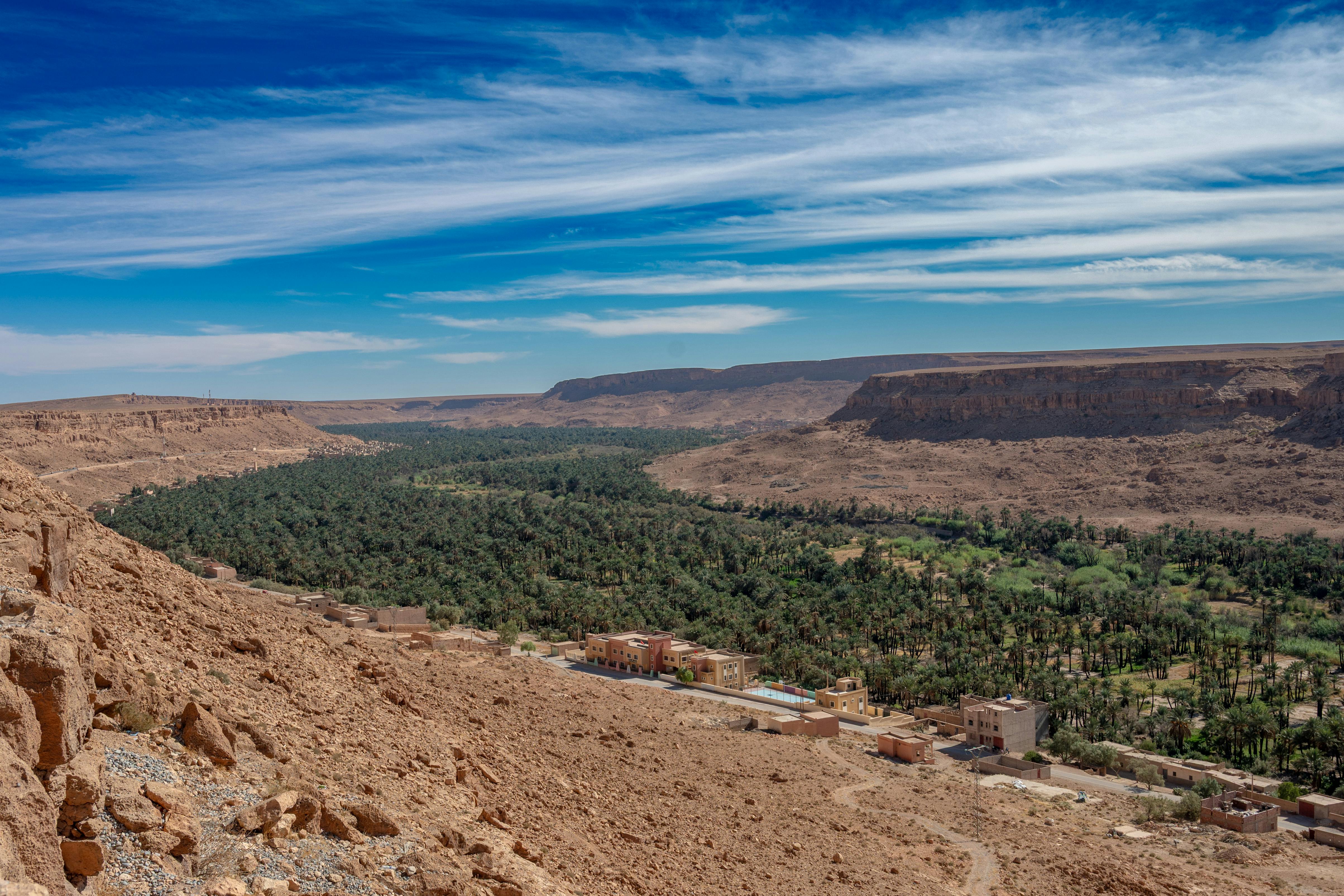
The Ziz Valley gorges north of Errachidia — one of the most beautiful approach roads to the Sahara in Morocco.
There is no single "Marrakech to Merzouga" route — there are three main approaches, and the choice of route changes the journey significantly. Understanding them helps you plan honestly rather than assuming one standard option exists.
From Marrakech via Tizi n'Tichka and the Draa
Distance: approximately 560km. Driving time: 7–9 hours with stops. This is the most commonly sold route. The road south crosses the High Atlas at the Tizi n'Tichka pass (2,260m — the highest paved road in Morocco). The descent into the pre-Saharan south is dramatic and the change in landscape happens quickly. Ait Ben Haddou (UNESCO ksar) is the most significant stop on this approach — plan 90 minutes minimum, not a quick roadside photo. The route continues through Ouarzazate and then east along the Kasbahs Road (N10) past Skoura, the Dades Gorge, and Todra before reaching Merzouga. The Draa Valley route from Ouarzazate is an alternative that adds a magnificent palmery corridor.
From Fes via Ifrane, Azrou, and the Ziz Valley
Distance: approximately 430km. Driving time: 6–7 hours with stops. This is our preferred approach when it fits the itinerary. The road south from Fes passes through Ifrane (a French-colonial mountain town at 1,650m, unexpectedly European in appearance), then Azrou and the cedar forest where Barbary macaques are visible from the roadside — the only wild primates in Africa north of the Sahara. The road drops through the extraordinary Ziz Gorges, past the Hassan Addakhil reservoir, and into an increasingly arid landscape before reaching the Tafilalet. If you arrive from this direction, Rissani comes before Merzouga — which allows a natural stop in the historic town before the dunes.
From Casablanca
Distance: approximately 600km via Fes. Driving time: 9–11 hours total. Most travelers from Casablanca route through Fes, breaking the journey with a Fes overnight. Direct routes exist but are less interesting. The Casablanca–Fes leg is approximately 3–4 hours on the motorway; from Fes, follow the Ziz Valley approach above.
The road conditions honestly
The main routes are paved and in reasonable condition throughout. The Tizi n'Tichka pass requires slow, cautious driving in winter (snow and ice possible). The final approach road from Erfoud to Merzouga is a good paved road. Some of the smaller side roads into the dunes from the Merzouga camp zone are unpaved tracks — a standard car handles these fine in dry conditions. If you are planning to drive independently, research current road conditions before departure; if you are with a private driver, this is handled for you.
Worth knowing: The direction of travel changes what you see first. Approaching Merzouga from the north via the Ziz Valley, the dunes appear on the horizon when you are still 15km away — a slow, building approach. Approaching from the Draa and Ouarzazate, the final hour is through flat desert scrub before the Erg rises suddenly. Both are impressive. The Ziz approach is our preference.
What to expect at desert camp
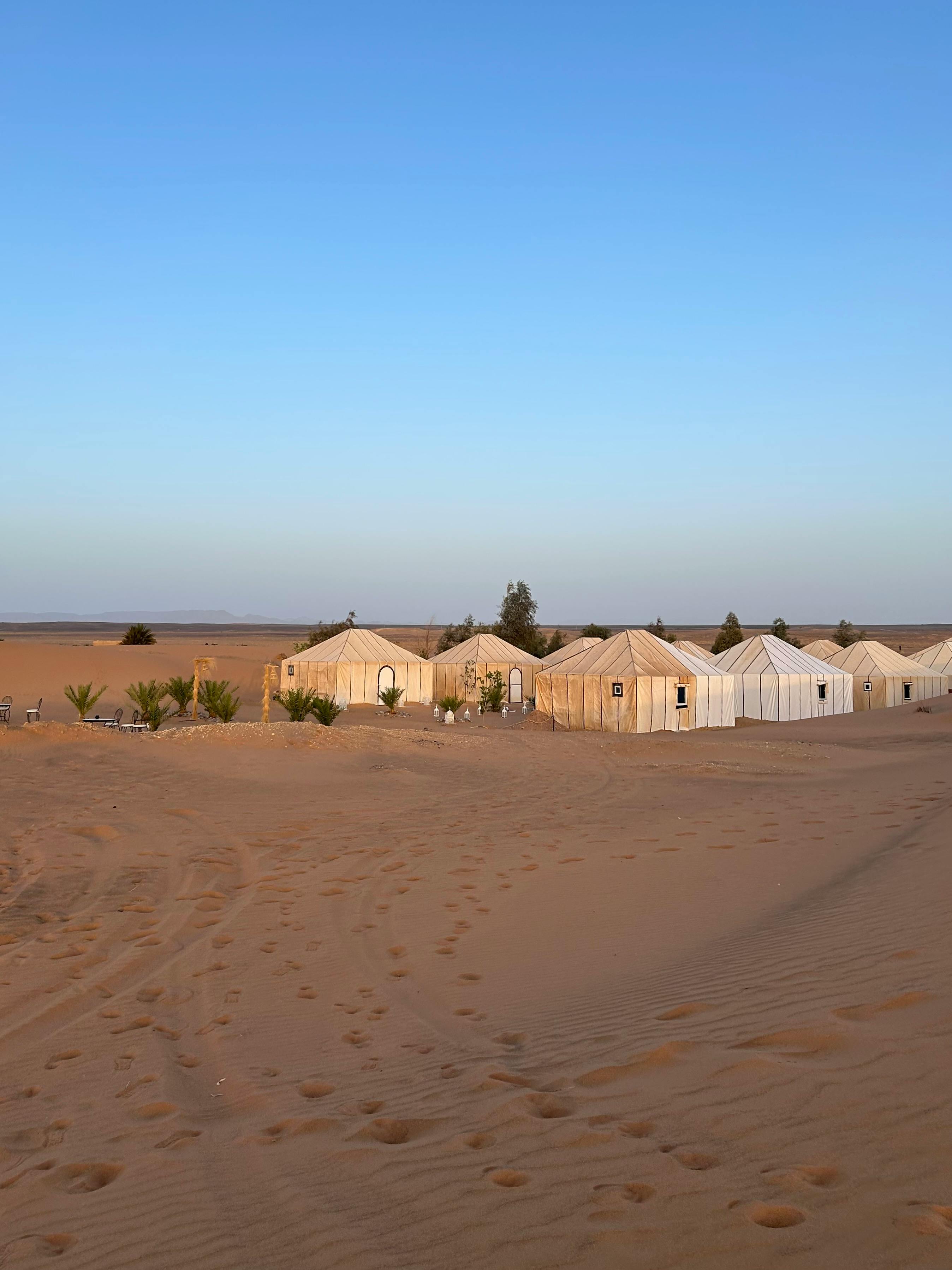
A comfort-level camp at the edge of Erg Chebbi — private tents, served dinner, the dune wall behind.
Desert camp photography is extraordinary and often accurate. The dunes really do look like that. The sky really is that dark. The experience is genuinely special. What the photos do not show is the full picture — and a realistic understanding of what you are booking makes the actual experience much better.
Standard camp
Standard camps at Erg Chebbi are typically clusters of Berber tents (the traditional goat-hair or heavy canvas tents with woven interiors) near the main camp zone at the dune edge. Facilities are shared — there will be bathroom tents some distance from the sleeping tents. Beds are mattresses on the ground with blankets and pillows. Dinner is served communally — typically a tajine or couscous. The experience is authentic and the location is the same as any other camp. The limitation is comfort after dark: shared facilities, less privacy, and in busy season the camp may have other groups nearby.
Comfort camp
Comfort camps have private tents — each tent has its own attached or adjacent bathroom, with a squat or Western toilet and a shower that works reliably in warm months (water pressure varies). Beds are proper raised beds, not mattresses on the ground. Dinner is served in a communal area and is a step up in quality. The tents have carpet, lanterns, and low furniture. This is the level we recommend to most travelers — the private bathroom alone makes a significant difference to the experience.
Premium camp
Premium camps are set apart from the main camp cluster — typically 10–20 minutes camel ride deeper into the erg, or positioned on a separate dune with a smaller total number of guests. The tents are larger and have real furniture: a proper bed with a frame, a sitting area, a private terrace facing the dunes. Meals are served individually rather than communally. The key difference at this level is quiet and isolation — you are more likely to have the dune to yourself in the early morning.
What the photos never show
Sand gets into everything. Your shoes, your bag, your camera, your food. This is not a complaint — it is the desert — but it is worth knowing before you pack. Camp bathrooms are functional but not hotel-caliber. In peak season (April, October, school holidays) the main camp zone has significant activity — other groups, camels passing, voices from neighboring camps. The deeper into the erg you are, the quieter. Wind at night is common and can be strong in spring — the tent fabric makes noise. None of this diminishes the experience, but knowing it helps you arrive with accurate expectations rather than disappointment.
The night sky
Merzouga is far enough from any city that on a clear moonless night the Milky Way is visible to the naked eye as a dense band across the sky. This is not an exaggeration. If you have never seen the Milky Way properly, this may be the first time. Check the lunar calendar for your dates — a full moon washes out stars significantly. The best nights for astrophotography (and for the raw experience) are around new moon.
What to pack for the Sahara
Most packing guides for Morocco are generic. What you need for the Sahara depends on when you go. The list below is organized by season, not by product category.
Always — regardless of season
- Head and face covering. A keffiyeh (Berber scarf, available in every Moroccan market for a few euros) is the most practical item you can bring. It blocks sun, keeps sand out of your face in wind, and keeps you warm at night. Bring one — or buy one in Morocco before you head south.
- Sunglasses with UV and sand protection. Wraparound styles are better than fashion frames in the desert. Polarised lenses are useful for the dunes.
- Sunscreen. At altitude on the dunes, UV exposure is significant even in winter. Apply it before the camel ride regardless of what the air temperature feels like.
- Closed walking shoes. For the dunes specifically. Sand in sandals makes walking difficult and uncomfortable after ten minutes. Running shoes or lightweight hiking shoes work well. Bring a spare pair for the camp.
- Power bank. Camps may have charging points but assume they don't. A 10,000mAh power bank handles 2–3 phone charges comfortably.
- Small daypack or bag with a zip. For dune walks. Keep valuables in a sealed bag inside — sand finds its way into every opening.
- Torch or headlamp. Camp paths at night are not lit. A small headlamp is useful and small to pack.
In summer (June–August): add heat management
- Lightweight long-sleeved tops and trousers (loose, pale colours). Cover your skin — shade on the dunes comes from clothing, not trees.
- Electrolyte sachets or tablets. Sweating in 43°C heat is rapid. Plain water is not enough for extended outdoor time.
- Schedule outdoor time for 5–8am and 6–8pm. Bring something to do during the midday hours.
In winter (December–February): add warmth
- A proper sleeping bag or a sleeping bag liner. Camp blankets may not be sufficient in below-5°C temperatures. If you are a cold sleeper, bring your own.
- A fleece or down jacket. The temperature difference between midday (15–20°C) and 3am (0–5°C) is extreme and rapid after sunset.
- Warm socks and a thermal base layer. These take almost no space and make the difference between a comfortable night and a miserable one.
What to leave behind
Rolling suitcases do not work on desert tracks and camp paths — use a soft bag or backpack for the desert portion. Do not bring anything fragile or of high sentimental value that cannot be replaced if damaged by sand. White linen, while omnipresent in desert travel photography, becomes beige within ten minutes. Leave expensive watches and jewelry at your hotel in Marrakech or Fes — there is no need for them in the desert and they attract unwanted attention in markets.
Understanding Erg Chebbi
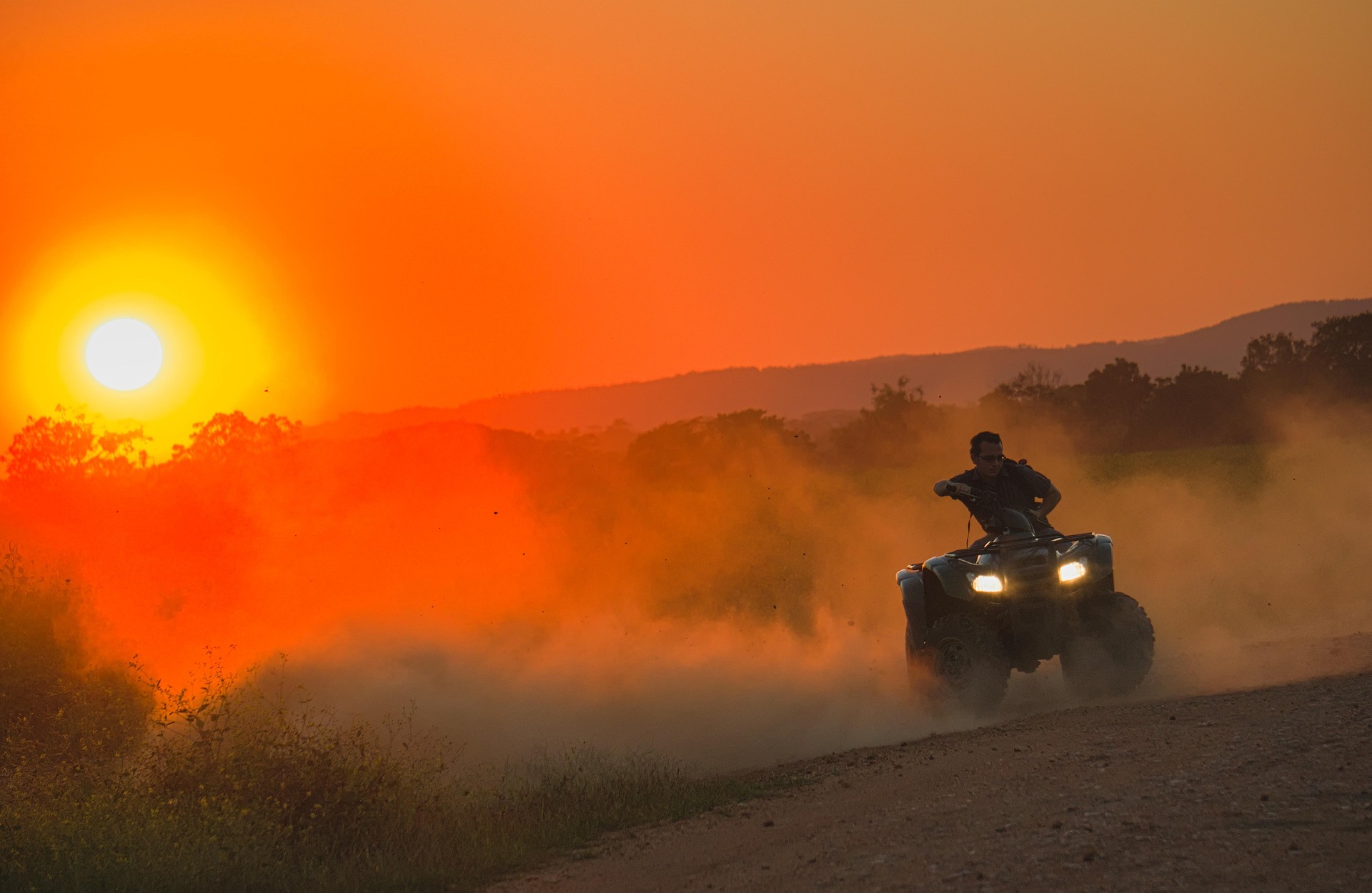
Erg Chebbi from the dune crest — 22km of sand sea, up to 150m high at the largest formation.
Most visitors arrive at Erg Chebbi with a vague understanding that it is a large area of sand dunes. It is, but the specifics matter for how you plan your time there.
What an erg is
An erg is a sand sea — a large area of desert covered in sand dunes shaped by wind. It is different from a reg (a flat, stony desert surface) or a hammada (a flat rocky plateau). Erg Chebbi is Morocco's most dramatic erg. It is not the entire Moroccan Sahara — the Sahara extends for thousands of kilometres in all directions — but it is the most accessible and visually striking formation in the country.
The dimensions
Erg Chebbi is approximately 22km north to south and 5–8km east to west. The highest dunes reach 150m — tall enough that the dune crest takes 20–30 minutes to climb on foot through loose sand. Most of the camp infrastructure is concentrated at the northern and central western edge, near Merzouga village. The southern end of the erg, near the village of Khamlia, sees far fewer visitors.
How dunes move
The dunes at Erg Chebbi are not static. Wind — predominantly from the northeast — moves sand continuously, shifting dune crests over weeks and months. Paths that exist in one season may be covered in the next. The erg after a significant windstorm looks markedly different from the day before. This is part of what makes it a living landscape rather than a geological monument.
Finding solitude in a large erg
The main camp zone is busy. Between 4pm and sunset, dozens of camel groups converge on the most photogenic dune faces near the camps. If you want the dunes without other people in your photographs or your view, you have three options: walk south along the erg's western edge for 30–40 minutes before sunset (most groups don't walk that far), wake before 5am (camel groups typically don't move until 5:30am at the earliest), or position yourself on the eastern face of a dune rather than the western face where camps and groups concentrate.
About Dayet Srji: The seasonal lake at the northern edge of Erg Chebbi (also called Lac Merzouga) fills in winter and spring when rainfall is sufficient — it can attract flamingos and other migratory birds. In summer and dry years it is empty. Check current conditions if wildlife photography is part of your plan.
Beyond the dunes — Rissani, Khamlia, and the Tafilalet
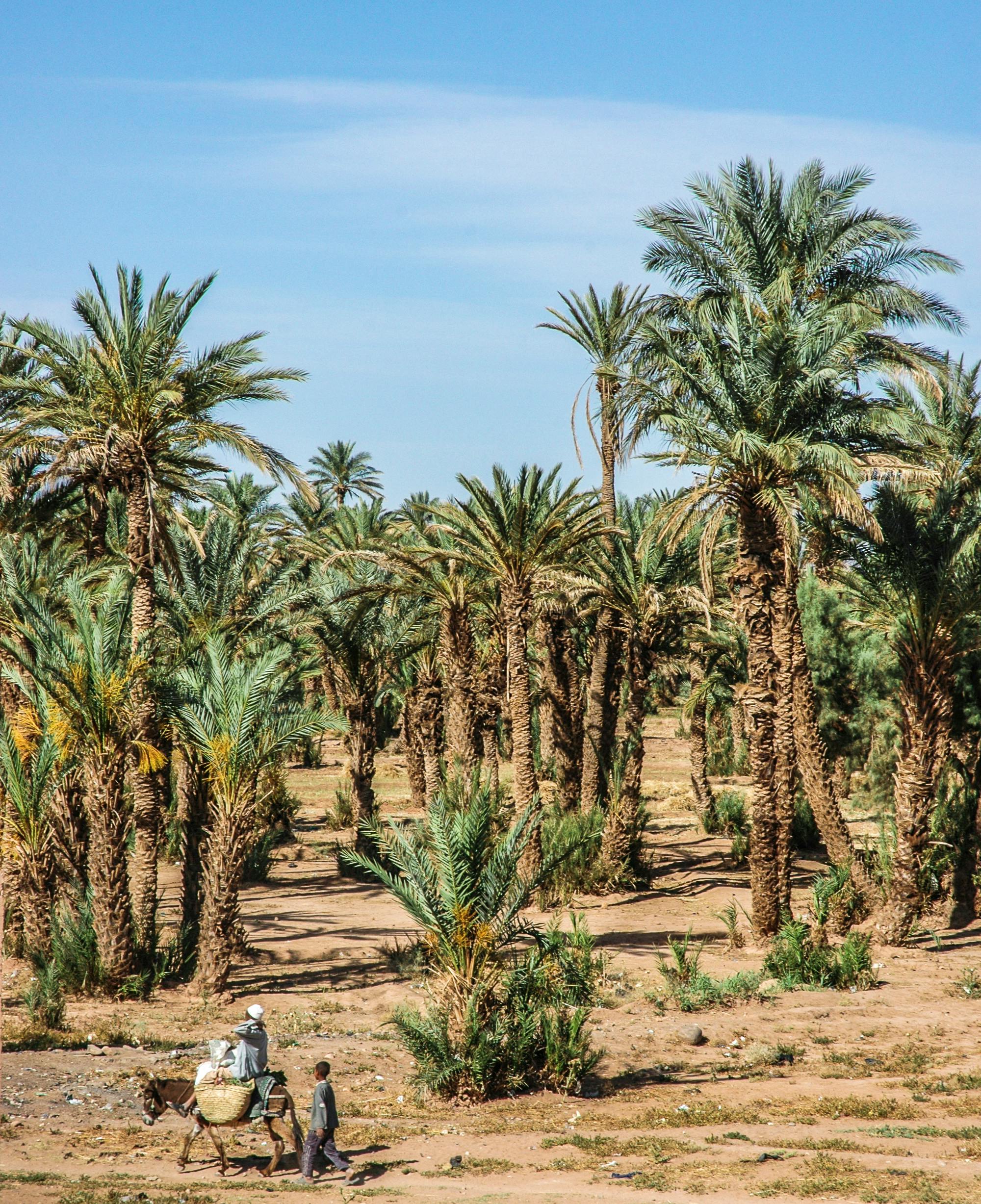
Rissani — the ancient Tafilalet capital and birthplace of the Alaoui dynasty, 23km from Merzouga.
Most visitors to Merzouga spend their entire time within 2km of their camp. This is understandable — the dunes are the reason they came, and the dunes are extraordinary. But the Tafilalet region around Merzouga has a depth that repays exploration, and most of it goes unseen.
Rissani
Rissani is 23km south of Erfoud and approximately 40km from Merzouga. It is the historical capital of the Tafilalet — one of the most significant regions in Moroccan history. The Alaoui dynasty, which has ruled Morocco since the seventeenth century and whose current king is Mohammed VI, traces its origins to the Tafilalet. The town's religious and historical significance is considerable, though it wears this lightly.
The souk runs three days a week (Sunday, Tuesday, and Thursday morning). The livestock market — held in the large open area outside the main souk — is one of the most authentic market experiences in the south of Morocco, completely unorganised for tourists. The souks themselves carry dates (the Tafilalet dates are among the best in Morocco), fossils (the region sits on a vast Cambrian-period fossil bed), leather goods, and local produce. The weekly rhythm of the town is organised around these market days.
The ksar of Abbar (also written Abbar or El Abbar) nearby is the largest of the historical fortified villages in the Tafilalet area — substantial ruins, largely unvisited, with good architectural photography possible. The palmery extending south of the town is one of the larger date palm groves in Morocco. Taoufiq grew up in this town. We visit it as locals, not as a tourist stop.
Khamlia
Khamlia is a small village 4km south of Merzouga, on the edge of the dunes. It is home to a Gnawa community — the Gnawa are a people of sub-Saharan African origin, descendants of enslaved communities brought to Morocco centuries ago, whose music and spiritual practice is one of the most distinctive traditions in North Africa. Informal music sessions happen at homes in the village — not performance arranged for tourists, but the actual practice of a living musical tradition. A visit to Khamlia takes a half afternoon and is consistently one of the strongest memories visitors take from the Tafilalet.
Erfoud
Erfoud (30km north of Merzouga) is best known for two things: the fossil marble industry and the annual Date Festival in October. The fossil marble — dark stone embedded with trilobite and ammonite fossils from the Devonian period — is quarried locally and worked into table tops, decorative objects, and architectural elements. A visit to one of the workshops is genuinely interesting. The fossils embedded in some Moroccan hotel floors and restaurant tables were almost certainly quarried in the Erfoud area.
The palmery between Erfoud and Rissani
The Tafilalet palmery is the largest date palm oasis in Morocco and one of the largest in North Africa — approximately 300,000 palms in a series of connected gardens and groves. The quality of Tafilalet dates is exceptional; the Medjool and Boufegous varieties are harvested in October and November. Driving or walking through the palmery in the late afternoon light is one of the quieter, more beautiful experiences in the region and requires no guide or planning.
Photography in the desert
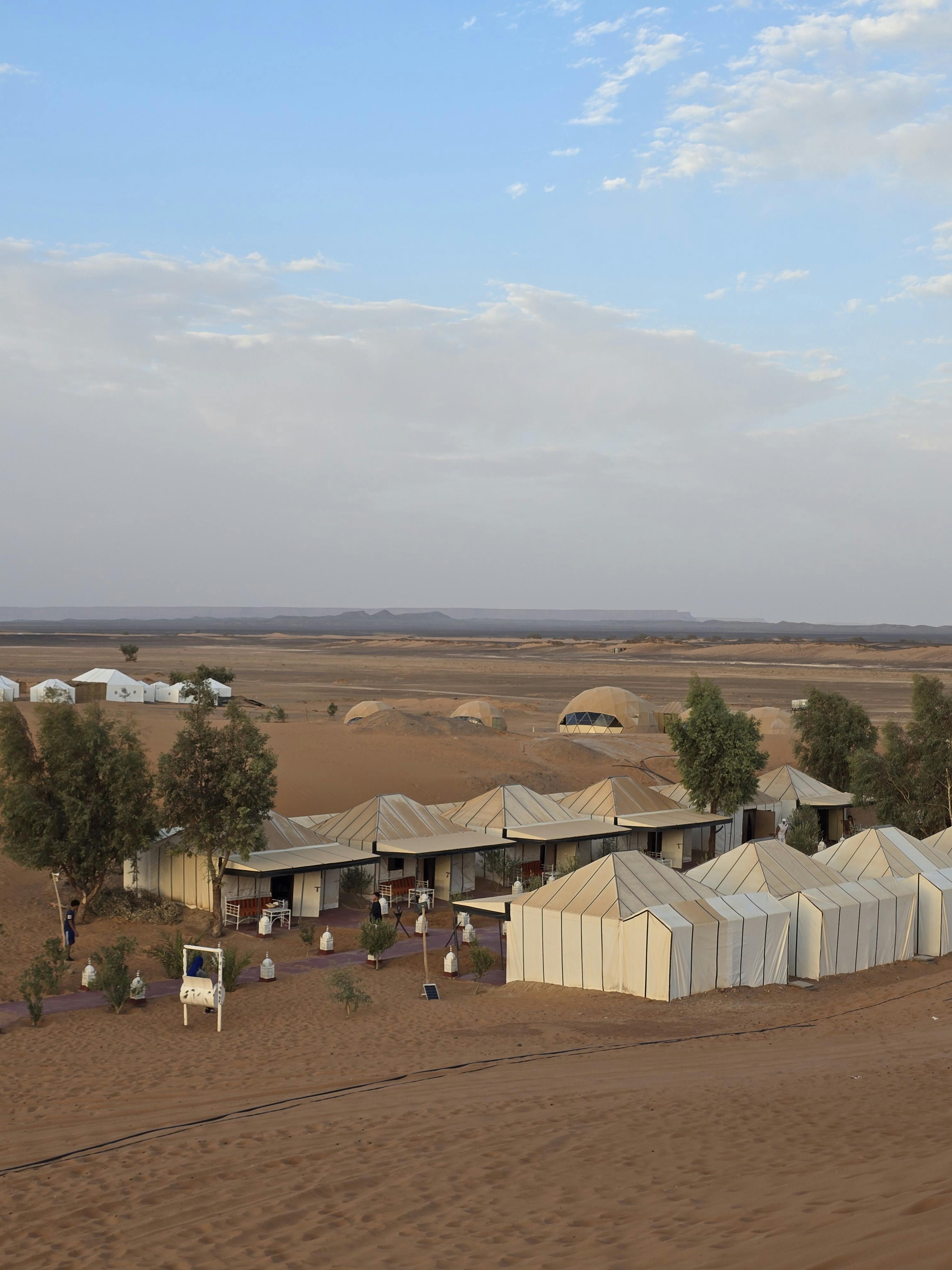
The transition from dusk to full dark at camp happens quickly — 20 minutes of extraordinary light before the stars take over.
The Sahara is photographed constantly and most of the photographs look the same: a silhouette on a dune crest at sunset, a camel against an orange sky, a tent with a lantern. These images are not wrong — the light at those moments genuinely is that colour — but they represent one hour of one day. The desert offers much more than its most photographed moment.
When to be in the dunes, and for what
Before sunrise (5–7am depending on season): This is the best light for dune texture. The sun comes from the east and rakes across the sand faces at a low angle, creating deep shadow in every ripple and ridge. The colours are cool — blue-grey to pale gold. The dunes are often empty. If you want photographs that don't look like everyone else's, this is the hour.
Sunrise: The eastern dune faces light first. The western faces remain in shadow. The light transition happens fast — you have about 20 minutes before the flat overhead light of morning flattens the dune texture.
Midday: Avoid for dune photography. The overhead sun removes all shadow and the sand appears flat and featureless. Good for portraits in open shade if the light is diffuse.
Afternoon to sunset (2–4 hours before dark): The most photographed period. The western dune faces light from the low sun; the eastern faces are in shadow. The colours move through gold, amber, and orange in sequence. The challenge is that this is also when most camel groups are active — plan to position yourself away from the main routes.
After sunset: The sky holds colour for 20–30 minutes after the sun drops. Blue hour in the desert is extraordinary and underused. Try a slow exposure of the camp with the dune silhouette behind it.
Night: On a clear moonless night, the Milky Way core is visible from the Erg between roughly 10pm and 3am depending on season. A basic kit for night photography: a camera that handles ISO 3200–6400 cleanly, a wide lens, and a tripod. The sand vibration from wind can cause camera shake — bury the tripod legs an inch into the sand to stabilize.
Camera care in sand
Sand is harder on cameras than most photographers expect. In a sandstorm (even a moderate one), fine particles work into zoom lenses and focus rings within minutes. If wind picks up, put your camera in a sealed bag or inside your jacket. Do not change lenses outdoors in the Sahara — do it inside the tent. Carry a clean, dry microfibre cloth for the lens front element. Avoid blowing on the lens in the field — your breath contains moisture that accelerates abrasion with sand particles.
Breaking the standard composition
Turn around. Most photographers face the sun for dune shots. The shadow direction — behind you, away from the sun — often shows more dune texture than the lit face does. Shoot into shadow. Look for tracks, ripples, wind patterns in the flat sand between the large dunes. Look down at your feet as much as at the horizon.
Budget and pricing — what's real
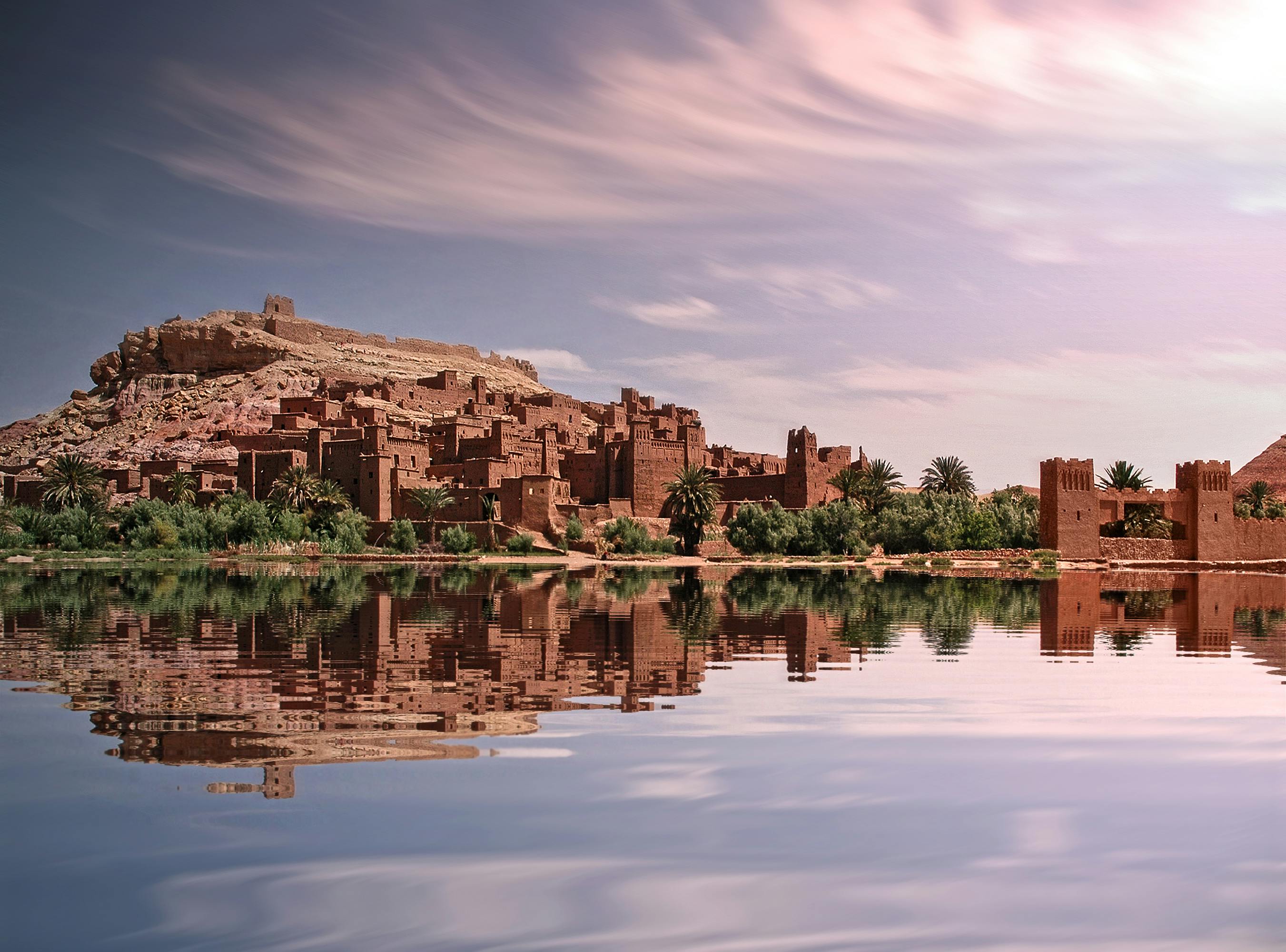
Ait Ben Haddou — one of the best-preserved ksour in Morocco, included on most Marrakech–Sahara routes.
The price range for Morocco Sahara tours is wide: from €250 for a 3-day group tour to €3,000 or more for a private premium week. Understanding what drives the price makes comparison between operators possible — without it, you are comparing numbers with no reference.
What you are actually paying for
A private Sahara tour price covers four main components: vehicle and driver/guide (the largest single cost), accommodation (which varies most dramatically with comfort level), fuel and tolls (significant on a 1,100km round trip), and a small operator margin. Everything else — meals, entry fees, tips, optional activities — is typically excluded and paid directly.
Group tours versus private tours
Group tours (typically 8–12 people in a shared minibus) are significantly cheaper per person — €250–€400 for a 3-day route from Marrakech is common. The trade-off is schedule flexibility, accommodation decisions made for the group rather than for you, and the presence of other people throughout the journey. Private tours cost more because the vehicle, driver, and timing are exclusively yours. If you are two people sharing a private vehicle, the per-person cost is typically in the €300–€700 range for a 3–4 day route depending on comfort level.
What "all-inclusive" usually means
Most Sahara tour prices described as "all-inclusive" include vehicle, driver, accommodation, and usually breakfast. Dinner at camp is sometimes included, sometimes not — check specifically. Lunch is almost never included — you stop at a local restaurant en route and pay directly. Entry fees (Ait Ben Haddou: approx. 30 MAD per person) are usually excluded. The camel ride at Merzouga is usually included. Any optional activities in Khamlia, Rissani, or elsewhere are usually extra.
Price signals: what cheap usually means
A 3-day private Marrakech–Merzouga tour quoted at under €300 for two people almost certainly involves standard camp (shared facilities), basic guesthouses, significant driving with minimal stops, and an operator whose margins require very high volume. This is not necessarily bad — it depends entirely on your expectations. But it is worth knowing what level you are booking before you arrive. Ask specifically: what type of camp (shared or private facilities), what type of vehicle, and how many other groups will be at your camp.
How to compare quotes honestly
When comparing two quotes, confirm the same variables: number of days, number of nights, accommodation level (standard/comfort/premium), whether the camel ride is included, and whether meals are included. Quotes that differ significantly for ostensibly the same itinerary are usually differing on camp quality — the camp night is where the biggest price variation occurs, and it is also where the biggest difference in experience occurs.
Indicative price reference (2025, private, 2 travelers): 3-day standard: €590–800. 4-day comfort: €990–1,250. 5-day comfort: €1,280–1,580. These are for the vehicle/driver/guide and accommodation combined. See How Pricing Works for the full breakdown.
Common mistakes — and how to avoid them
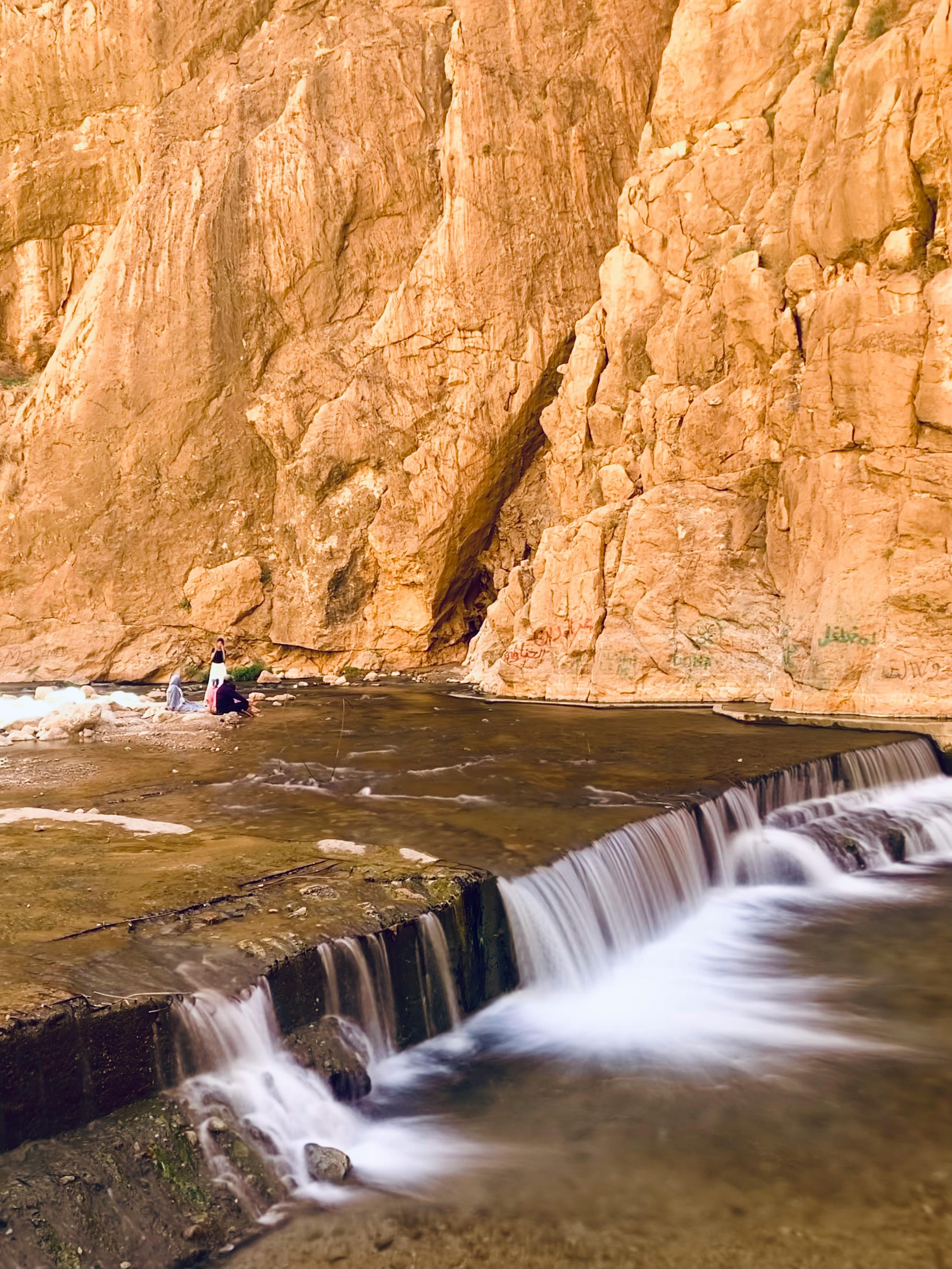
The Todra Gorge — 300m limestone walls rising from a narrow river valley. One of the most rushed stops on the standard Sahara route.
These are the mistakes that come up repeatedly — things travelers wish they had known before the trip. Most of them are easy to avoid with advance knowledge.
1. Going in July or August without knowing what that means
Summer in Erg Chebbi is genuinely extreme. Temperatures above 42°C are common; sand temperatures are significantly higher. This is manageable if you plan around it — early morning and evening outdoor time, shade during the day. It is not manageable if you arrive expecting comfortable all-day dune walking. Know what you are booking before you go.
2. Booking three days when the journey needs five
Three days from Marrakech and back is a 1,100km trip with one night at the dunes. On Day 2 you are already on your way home. If the Sahara is the point of your Morocco trip, three days does not give it adequate time. More travelers regret this choice than almost any other on this route.
3. Choosing a camp based on Instagram photographs
Desert camp photography is shot at magic hour, heavily edited, and selected from hundreds of images to find the one where the camp looks perfectly isolated. The reality of most camps is that you can see or hear other camps in the evening. Ask for the actual camp location on a map relative to the main camp zone — the distance from other camps tells you more than the photos do.
4. Rushing through Dades and Todra on the same day
Both gorges — Dades and Todra — are genuinely excellent. Driving through both on the same day as a transit to Merzouga means giving each about 30 minutes. This is enough to say you have been, not enough to experience them. Spending a night in one of them is the single adjustment that most improves the standard Sahara route.
5. Arriving in Merzouga after dark
The approach to Merzouga from across the Tafilalet plain, with the dune wall rising from the flat ground, is one of the most striking arrivals in Morocco. At night it is invisible. On a tight 3-day schedule, late departure from Marrakech or extended stops often mean arriving at camp in the dark. Leave early and arrive in daylight.
6. Not visiting Rissani
Most tours do not include Rissani because it requires local knowledge to navigate and the standard itinerary does not have room for it. If you have a private guide and a flexible schedule, ask specifically to include it. The souk (Sunday, Tuesday, Thursday) is the best reason to time your visit deliberately. See Chapter 7.
7. Expecting hotel standards at camp
Even premium desert camps are not hotels. The bathroom is not a hotel bathroom. The shower pressure varies. Sand is everywhere. The beds are comfortable but the sleep is lighter than in a hotel room — wind noise, temperature changes, and predawn camel activity all contribute. Expect an experience, not a luxury stay, and it will be excellent. Expect a hotel with sand outside and you will be disappointed.
8. Packing a rolling suitcase
Suitcases with wheels do not work on the unpaved tracks that connect camps. They sink, tip, and wheel-jam in sand. Use a soft duffel bag or a backpack for the desert portion of your trip. Leave your main suitcase at your hotel in Marrakech or Fes.
9. Not checking the lunar calendar
A full moon in the desert is beautiful but it overwhelms the stars. If a dark sky and visible Milky Way are important to your experience, plan to be at the dunes within a week of new moon. If you are flexible on dates, this is an easy optimisation. Lunar calendars for Morocco are easily found online.
10. Booking without asking about group size at camp
A "private" tour means your vehicle and driver are exclusively yours. It does not necessarily mean you are the only people at camp. Ask specifically: how many guests does the camp hold, and how many other groups will be there during your stay? The answer varies significantly between camps and seasons and is almost never in the brochure.

This guide is free and will remain free. If it was useful, the best way to support it is to share it — or to get in touch when you are planning your journey.